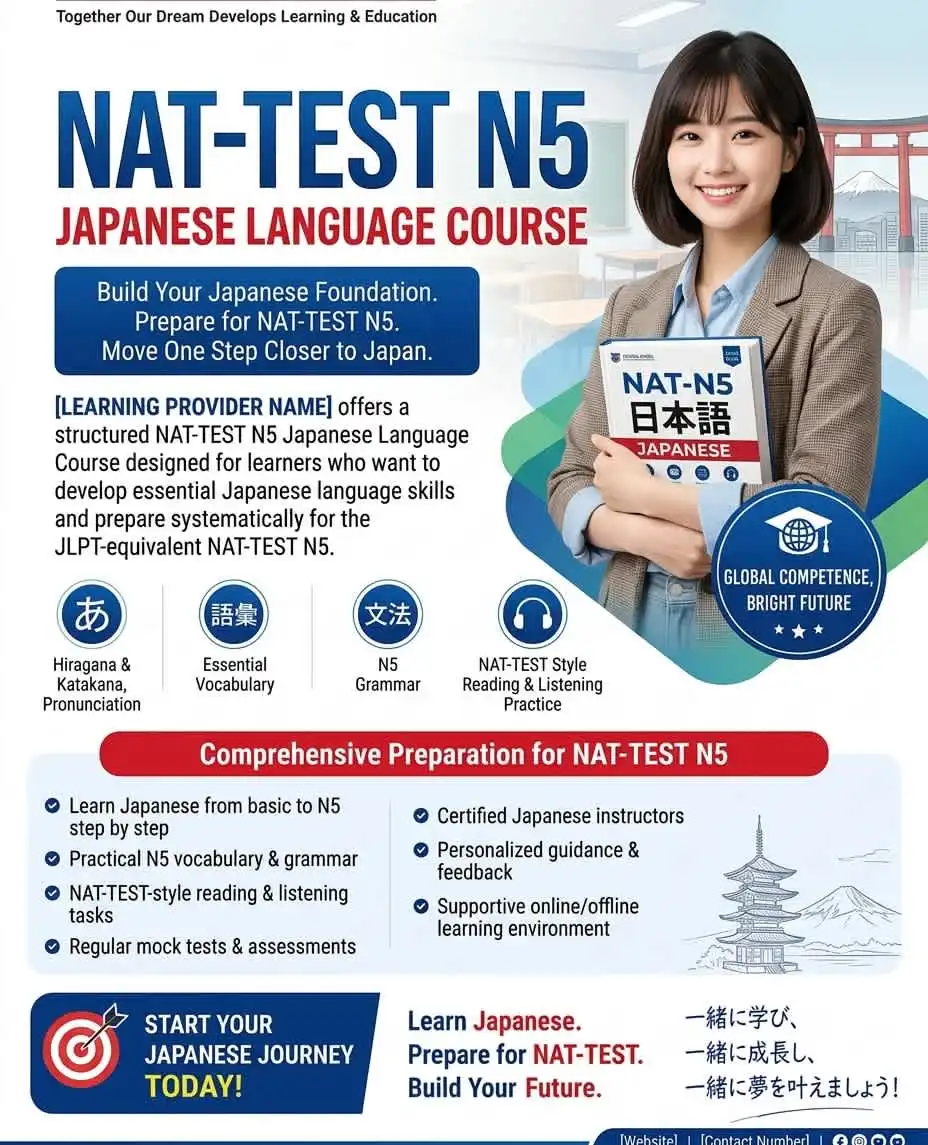
NAT-N5 Course
If you're applying to a Japanese language school, you've probably run into a wall of test names — "JLPT," "NAT-TEST," "JFT," "JCERT" — and no one's told you which one you actually need. "NAT-N5" is one of the answers to that confusion, and often the fastest one to act on.
"NAT-TEST" is a Japanese-language proficiency test series, running from Level 5 (beginner) up to Level 1 (advanced). N5 is the entry level — basic grammar, vocabulary, reading, and listening. Many Japanese language schools accept it as an admission credential, sometimes as a faster alternative when JLPT results aren't available in time.
This course gets you ready for that specific exam — not general Japanese conversation, not a different test's format. If NAT-N5 is what your target school is asking for, this is where you start.
What Is NAT-TEST N5? (And How It's Different from JLPT N5)
These are two separate tests, run by two different organizations, and mixing them up costs people time.
- "JLPT" (Japanese Language Proficiency Test) — the internationally best-known Japanese test, held only twice a year in most countries
- "NAT-TEST" — a separate proficiency test series, designed to the same difficulty standard as JLPT levels, but held far more often — around six times a year
- Level equivalence: NAT-TEST Level 5 is designed to match JLPT N5 in difficulty — same general skill level, different exam, different administering body, different test day
NAT-TEST N5 is accepted by many Japanese language schools as an alternative to JLPT N5 — which matters if your application deadline falls between JLPT sittings and you can't wait months for the next one.
Who Should Take the NAT-N5 Course?
- Complete beginners in Japanese who are starting from zero, including Hiragana and Katakana
- Students who've studied a little already — self-study, a short prior class — and want a structured, exam-focused push toward N5
- Anyone applying to a Japanese language school that requires or accepts an N5-level result as part of the application
If your target school specifically asks for JLPT rather than NAT-TEST, tell us early — we'll point you toward the right prep track instead.
What You'll Learn in Toddle's NAT-N5 Course
- Hiragana and Katakana — the two beginner scripts, read and written fluently
- Basic Kanji at the N5 level
- Beginner grammar patterns — sentence structure and the core forms tested at this level
- Everyday vocabulary covering daily life, school, and simple situations
- Listening and reading practice matched specifically to the NAT-TEST N5 format, not generic listening drills
[confirm exact syllabus breakdown]
NAT-N5 Exam Format and Test Dates
NAT-TEST N5 is tested across three sections, all multiple-choice:
- Language Knowledge — vocabulary and kanji
- Language Knowledge — grammar and reading comprehension
- Listening
Test frequency: NAT-TEST is held around six times a year — a real advantage over JLPT's twice-yearly schedule if you're working against an application deadline.
Test centers in Nepal: typically Kathmandu, Pokhara, and Bharatpur — [confirm current test dates and nearest center].
Toddle NAT-N5 Course Highlights
- [confirm instructor name and Japanese-language teaching credential]
- Structured beginner curriculum built around the NAT-TEST N5 format — not generic conversation practice that doesn't map to the actual exam
- Regular mock tests so you know where you stand before test day
- Small batch sizes
- Guidance connecting your NAT-N5 result to Japanese language school applications — so passing the test isn't the end goal, getting into your target school is
Course Duration, Schedule & Fees
- Duration: [confirm current course duration]
- Schedule: [confirm current timetable — morning/evening batch availability]
- Fee: [confirm current fee]
Ask at the office for the next available batch and its start date relative to the next NAT-TEST sitting.
What Happens After the NAT-N5 Course?
Passing N5 isn't the finish line — where you go next depends on your application timeline:
- Progress toward N4, then N3 if your target school or program needs a higher level before you apply or before arrival
- Apply to your Japanese language school with your N5 result as part of the application package
- Move toward JLPT if your specific school or later visa stage requires JLPT results instead of, or in addition to, NAT-TEST
We'll help you map out which of these applies to your specific school before you finish this course.
Frequently Asked Questions About the NAT-N5 Course
What is the difference between NAT-TEST and JLPT?
They're separate exams from separate organizations, built to the same difficulty standards. JLPT is held twice a year; NAT-TEST is held about six times a year, which makes it useful when you're working against a tighter application deadline.
Is NAT-N5 accepted by Japanese language schools?
Many schools accept it, often as an alternative when JLPT results aren't available in time. Requirements vary by school, so we confirm what your specific target school accepts before you commit to a test.
Do I need any prior Japanese knowledge to join?
No. This course starts from the beginning, including Hiragana and Katakana, for students with zero background.
How often is the NAT-TEST held?
Around six times a year, compared to JLPT's twice-yearly schedule — one of the main reasons students choose it when time is tight.
What comes after passing NAT-N5?
Most students move toward N4 or apply directly to their Japanese language school with the N5 result, depending on what the school requires.
Is the NAT-N5 course enough on its own, or will I also need JLPT?
It depends entirely on your target school's requirements. Some accept NAT-TEST results outright; others specifically want JLPT. We check this with you before you start preparing, not after.
Ready to Start Your NAT-N5 Preparation?
Book a seat in the next Hetauda batch, or WhatsApp us at +977 57-525392 to check the next test date and current schedule.