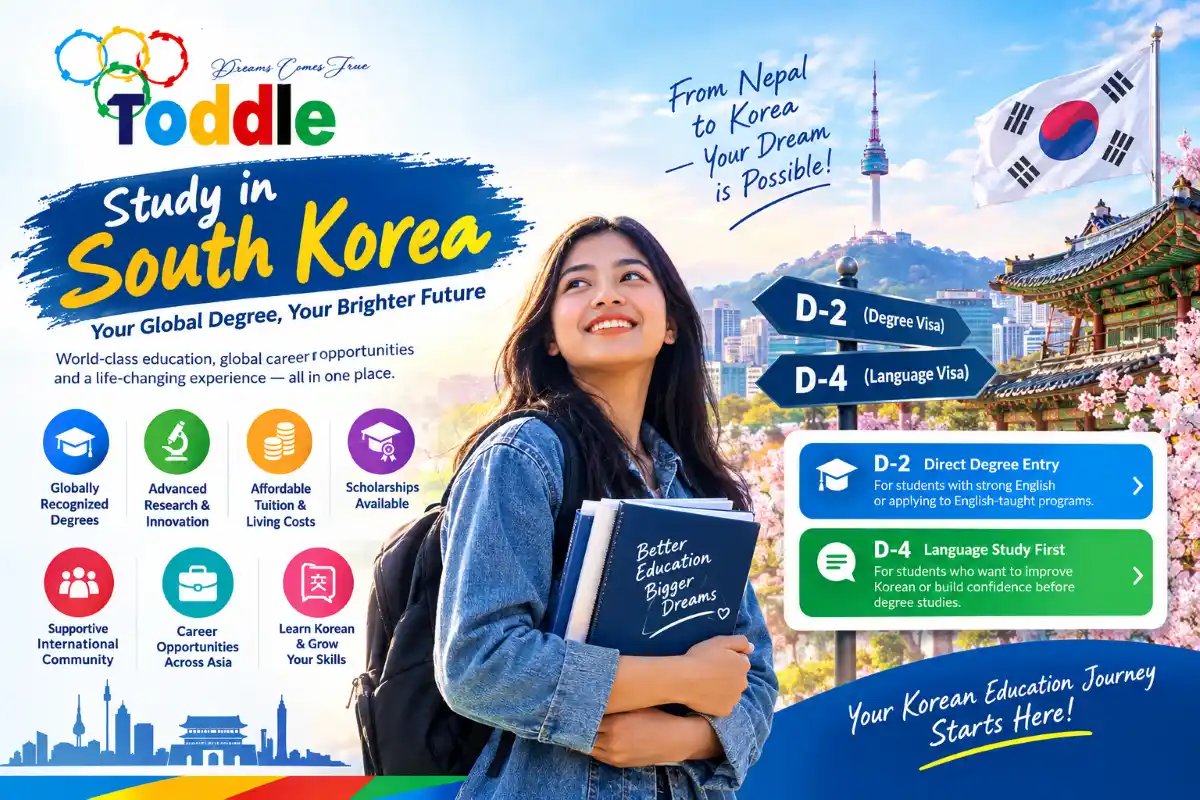
Study in South Korea from Nepal
Introduction
Every year, hundreds of Nepalese students dream of a world-class degree paired with an international career launch. And many are choosing South Korea—a decision that's growing smarter each year. Why? Korea offers globally recognized degrees, cutting-edge research facilities, affordable tuition compared to the US or UK, and a structured pathway designed specifically for international students like you.
But the journey from "I want to study in Korea" to "I'm enrolled at a Korean university" involves real decisions: Which visa? Which universities? What about costs and timelines? This guide answers all of it.
By the end, you'll know:
- Why Korea is an excellent choice for Nepalese students
- The two main pathways (D-2 degree visa vs. D-4 language visa)—and which fits you
- A step-by-step process from application to arrival
- Common pitfalls to avoid
- Where to get expert support
Let's break it down.
Why Nepalese Students Are Choosing South Korea
A Growing Education Hub
South Korea has become a top destination for international students—and there's good reason. The country hosts over 150,000 international students annually, with growing numbers from Nepal. Universities invest heavily in English-taught programs, modern facilities, and student support services tailored to international cohorts.
Key Benefits for You
Globally Recognized Degrees & Strong Research Korean universities consistently rank in the global top 100. Degrees are recognized worldwide, especially in STEM fields. If you're aiming for IT, engineering, biotechnology, or business, Korean universities offer competitive research opportunities and industry connections.
Growing English-Medium Programs One common worry: "But I don't speak Korean yet." Many Korean universities now offer bachelor's and master's programs entirely in English—no TOPIK (Korean language test) required. Examples include Seoul National University's Graduate School of International Studies, KAIST's engineering programs, and numerous private universities.
Learn Korean While You Study Even if you start with an English program, most campuses offer free or affordable Korean language classes. Many students build Korean fluency over their degree, making them more competitive in Asia-Pacific job markets.
Affordable Than Western Alternatives Tuition at Korean universities typically ranges from ₩8–15 million per year (roughly $6,000–$11,000 USD)—significantly less than comparable UK or US programs. Living costs in secondary cities like Daegu or Busan are even more affordable than Seoul.
Scholarship Opportunities Korean universities and the government offer scholarships for international students. Many cover full or partial tuition; some include living stipends. Competition exists, but merit-based opportunities are real.
Strong Student Support Services Most universities have dedicated international student offices, orientation programs, and peer mentoring. Student dormitories are common, safe, and affordable—a huge advantage for adapting to life in a new country.
Pathways to Regional Careers A Korean degree opens doors in South Korea, but also across Asia. Many multinational companies in India, Southeast Asia, and beyond value Korean education and English fluency.
The Two Pathways: Understanding D-2 and D-4 Visas
Your first big decision: Do you apply directly to a degree program, or start with Korean language study first?
Pathway 1: Direct Degree Entry (D-2 Visa)
Choose D-2 if:
- You already have strong English proficiency (IELTS 6.0+, TOEFL 80+, or equivalent)
- You're applying to English-taught programs
- You want to minimize time and start degree coursework immediately
- Your GPA and test scores meet university admissions standards
What is D-2? The D-2 is South Korea's long-term student visa for degree programs (bachelor's, master's, PhD). Once you're admitted to a Korean university, you apply for the D-2 visa. It's valid for the duration of your program (typically 2–4 years) and can be renewed.
Timeline:
- University applications: 2–3 months before intake (varies by university)
- Admission → Visa application: 1–2 months
- Total from application to arrival: 5–8 months (if you start early)
Real Example: Anita (Nepal, IT major, 3.7 GPA): Anita identified three Korean universities with English-taught computer science programs. She applied in October for Spring 2025 intake. With her strong GPA and IELTS score, she was admitted in January, applied for the D-2 visa in February, and arrived in Korea in March. Total time: 5 months.
Pathway 2: Language Study First (D-4 Visa)
Choose D-4 if:
- Your English proficiency is below university entry level
- You want to improve Korean before or alongside studies
- You're considering both English and Korean-taught programs
- You want a "soft landing" before committing to a full degree
What is D-4? The D-4 is a long-term student visa for studying at a university language institute. You attend Korean language classes (typically 4 weeks per level, ranging from beginner to advanced TOPIK 6). Many students aim for TOPIK 3 or 4 (3–6 months) before transitioning to a degree program.
Timeline:
- Language program applications: Relatively flexible; multiple intakes per year
- Language study duration: 3–12 months (depending on your starting level and target level)
- Transition to D-2: Once you meet university English requirements or Korean requirements for Korean-taught programs
- Total from application to degree start: 8–14 months (varies)
Real Example: Rajesh (Nepal, business major, intermediate English): Rajesh's IELTS was 5.5—below university requirements. He applied for a D-4 language program in July, started in August, and studied Korean for 5 months while also taking free supplementary English classes. By January, his Korean reached TOPIK 3 level, making him eligible for Korean-taught business programs. He applied to universities in January and began his master's degree in September. Total time: 14 months.
Side-by-Side: Which Pathway for You?
| Factor | D-2 (Direct Degree) | D-4 (Language First) |
|---|---|---|
| Starting English Level | IELTS 6.0+, TOEFL 80+, or strong equivalent | Below 6.0; working to improve |
| Time to Start Degree | 5–8 months | 8–14 months |
| Tuition (Language) | N/A | ₩1.5–2.5 million/year |
| Tuition (Degree) | ₩8–15 million/year | ₩8–15 million/year (after language) |
| Best For | Clear fit; ready to start immediately | Building confidence; exploring career options in Korea |
| Visa Flexibility | Tied to one university; changing universities requires new visa | Can explore before committing to a degree program |
Step-by-Step Process: From Decision to Arrival
Step 1: Assess Your Profile (Weeks 1–2)
Before applying anywhere, know your own numbers:
- Academic Record: Calculate your GPA (or equivalent). Most Korean universities expect 2.5+, with top universities requiring 3.2+.
- English Proficiency: Take IELTS or TOEFL if you haven't. Know your score honestly.
- Budget: How much can you spend? (See cost breakdown below.)
- Career Goal: What major? What outcome after graduation? (Korea or return to Nepal?)
Action: Write a brief summary: "I'm a [GPA] student with [language level], aiming for [major] at a [budget range] university in [city]."
Step 2: Research & Shortlist Universities (Weeks 2–6)
Korean universities range from world-renowned (Seoul National, KAIST, Yonsei) to solid regional universities. Don't assume the most famous is your only option.
Build your list in three tiers:
- "Ambitious" (1–2 universities): Top-ranked, highly selective. Examples: Seoul National, KAIST, Korea University.
- "Moderate" (2–3 universities): Mid-ranked, good reputation, realistic acceptance. Examples: Ewha Womans University, Sogang University, Kangwon National.
- "Safe" (1–2 universities): Solid quality, friendly to international students, likely acceptance. Examples: Konkuk University, Sookmyung Women's, Catholic University.
Key research points:
- Does the program you want exist in English or Korean?
- What's the admission timeline for your desired intake?
- What are the language requirements?
- Are scholarships available?
- What's the university's international student support?
Resources:
- Korean university websites (most have English versions)
- QS World University Rankings (filter by country/region)
- Study in Korea portal (www.studyinkorea.go.kr)
Step 3: Prepare Your Documents (Weeks 6–12)
Each university's requirements vary slightly, but most ask for:
Core Documents:
- ✅ Completed application form (usually online)
- ✅ Bachelor's transcripts (or equivalent)—official, with English translation if needed
- ✅ Diploma/proof of graduation (with official stamp)
- ✅ Passport (valid for ≥2 years)
- ✅ English language test results (IELTS / TOEFL / equivalents as per program requirements)
- ✅ Statement of Purpose (SOP)—usually 500–800 words explaining your academic goals and why this program
Important for Nepalese Students:
- Documents from Nepal often need official stamps/seals and English translation.
- Start this process early; translations and notarizations take time.
- Contact your school's registrar in Nepal to request official transcripts to be sealed and sent directly to the Korean university (many universities accept this).
Statement of Purpose Tips: The SOP is your chance to stand out. Many students write generic SOPs; yours should answer:
- Why do you want to study in Korea? (Not a generic answer.)
- Why this university and this program? (Show research.)
- What's your academic background relevant to this program?
- What are your career goals after graduation?
Example structure: "I completed my undergraduate in business at [University, Nepal]. My focus was on international trade, where I was fascinated by Asia's economic growth—particularly Korea's IT and startup ecosystem. I want to deepen my knowledge through a master's in [specific program] at [University], which uniquely combines [specific curriculum element] with real-world industry exposure. After graduation, I aim to return to Nepal and lead business development for tech startups, leveraging Korean industry best practices."
Step 4: Submit Applications & Receive Offer Letters (Weeks 12–16)
Most Korean universities accept online applications. Submission deadlines typically occur 2–3 months before the semester starts:
- Spring intake (March): Deadline usually October–November
- Fall intake (September): Deadline usually March–April
After submission:
- Universities typically respond within 4–8 weeks.
- You'll receive an offer letter (often as a PDF, later as official stamped document).
- Save all correspondence and confirmation numbers.
Step 5: Prepare for Visa Application (Weeks 16–20)
Once you have an offer letter, begin visa prep. You'll need:
For D-2 Visa:
- Offer letter from the Korean university
- Proof of financial capability (bank statement showing ~$15,000–$20,000 USD for one year, or equivalent)
- Passport
- Completed visa application form (available at the Korean embassy in Nepal)
- Proof of accommodation (university dorm contract or rental agreement)
- Certificate of health (some requirements)
- A sponsor letter (from a parent/guardian in Nepal, if needed)
For D-4 Visa:
- Offer letter from the language institute
- Similar financial proof and passport requirements
Timeline: Visa processing typically takes 2–4 weeks. Apply as soon as you receive your offer letter.
Where to apply:
- Korean Embassy in Kathmandu (if one exists) or the nearest Korean diplomatic mission
- Some countries now offer e-visa or online processing; check your country's embassy website
Step 6: Pre-Departure Planning (Weeks 20–24)
Housing
University Dormitories (Recommended for first year)
- Most affordable option: ₩200,000–500,000/month (~$150–$350 USD)
- Secure; includes utilities; social community
- High demand; apply as soon as admitted
- Many universities prioritize D-2 students for dorms
Off-Campus Rentals
- "Jeonse" (전세): Lump-sum deposit + low rent
- "Wolse" (월세): Monthly rent; typical deposit required
- More expensive than dorms but more independence
- Websites: Naver Apartment, Zigbang, Danbang
Insurance & Health
- Korean universities require health insurance enrollment
- International student health insurance:
₩80,000/month ($60 USD) - Covers doctor visits, hospitalizations, prescriptions
Arrival Checklist
- Book flights (budget airlines often cheaper; ~₩700,000–900,000 from Nepal)
- Arrange airport pickup (most universities offer this)
- Open a Korean bank account (visit bank within first week; bring passport + admission letter + dorm proof)
- Purchase SIM card (GCT, SK Telecom, KT; unlimited data ~₩30,000/month)
- Register with Nepali embassy if staying long-term (optional but recommended)
- Learn key Korean phrases (even basic phrases go a long way; "감사합니다" = thank you)
Cost Breakdown: What Will You Actually Spend?
Here's a realistic annual budget for a Nepalese student in Korea:
| Expense | Monthly (KRW) | Annual (KRW) | Annual (USD) |
|---|---|---|---|
| Tuition | — | ₩10–15M | $7,500–$11,000 |
| Dorm/Housing | ₩250–400K | ₩3–4.8M | $2,250–$3,600 |
| Food | ₩300–400K | ₩3.6–4.8M | $2,700–$3,600 |
| Transportation | ₩40K | ₩480K | $360 |
| Utilities/Internet | ₩50K | ₩600K | $450 |
| Health Insurance | ₩80K | ₩960K | $720 |
| Books/Supplies | — | ₩500K–1M | $375–$750 |
| Miscellaneous | ₩100K | ₩1.2M | $900 |
| TOTAL | ~₩820–1,200K | ~₩20–28M | ~$15,000–$21,000 |
Pro tip: Living outside Seoul (e.g., Daegu, Busan) reduces housing and food costs by 20–30%.
Common Mistakes to Avoid
❌ Mistake 1: Choosing Universities Without Checking Language of Instruction
The Error: You apply to a "top-ranked" university without confirming if your program is taught in English or Korean.
The Fix: Before applying, contact the department directly. Ask: "Is [program name] taught in English or Korean? What language proficiency is required?" Never assume.
❌ Mistake 2: Underestimating Living Costs, Especially in Seoul
The Error: You plan a budget based on tuition alone, forgetting dorms, food, and transport.
The Fix: Use the cost breakdown above. If your budget is tight, prioritize cities outside Seoul. Daegu, Daejeon, and Busan offer similar education quality at 20–30% lower costs.
❌ Mistake 3: Writing a Generic Statement of Purpose
The Error: "I want to study in Korea because it's a great country with good universities."
The Fix: Show specific research. "I want to study [program] at [university] because of its [specific strength], and I plan to [specific career goal]. My background in [relevant experience] makes me a strong fit."
❌ Mistake 4: Missing Document Deadlines or Skipping Translations
The Error: You submit transcripts without official seals or English translations, or miss a deadline because you underestimated processing time in Nepal.
The Fix: Start document prep 3+ months early. Request official transcripts from your school immediately. Confirm all translations are official (notarized), not just personal.
❌ Mistake 5: Not Planning for Post-Graduation Visa Options
The Error: You assume you must leave Korea after graduation.
The Fix: Korea offers D-10 (job seeker) visas for international graduates. If you want to work in Korea post-graduation, ask the university's career office early about employer connections and visa options.
Scholarship Opportunities
Korean universities and government bodies offer scholarships for Nepalese and other international students:
University-Based Scholarships:
- Many universities offer 25–100% tuition waivers based on merit (GPA) or need
- Application process: Usually included in your admission application
- Contact the International Student Office for details
Korean Government Scholarships:
- Global Korea Scholarship (GKS): Covers full tuition + living stipend (highly competitive; ~500 awards globally)
- NIIED Scholarship: Offered by the National Institute for International Education Development
- Applications typically open in Fall for next year's intake
Application tip: Don't wait for scholarship offers to decide on Korea. Apply to universities; many admit you first, then offer merit-based scholarships. Having an offer strengthens scholarship applications.
Real Student Stories
Anita's Direct Route (D-2)
Background: Anita completed her bachelor's in engineering from a Nepali university with a 3.7 GPA. Her IELTS score was 6.5. She researched Korean universities and identified three with English-taught mechanical engineering programs.
Journey: She applied in October for Spring 2025 intake. By January, KAIST extended an offer with a 50% tuition scholarship. She received her D-2 visa in February and arrived in Korea in March.
Outcome: One year into her master's, Anita joined a research lab, published a paper, and secured an internship at a Korean automotive company. She's now considering a PhD in Korea or returning to Nepal to start a tech consultancy.
Lesson: Strong academics and English proficiency can fast-track you directly into top programs with scholarships.
Rajesh's Language + Degree Path (D-4 → D-2)
Background: Rajesh completed his bachelor's in business from a Nepali university but had only intermediate English (IELTS 5.5). He also had no Korean background.
Journey: He applied for a D-4 language program in July, started in August, and studied Korean intensively for 5 months. By January, he'd reached TOPIK 3 level. He applied to universities offering Korean-taught business programs and received an offer from Ewha Womans University for their MBA starting in September.
Outcome: Rajesh is now in his first year of the MBA, fluent in Korean, and building a professional network in Korea. He's considering staying in Korea to work for 1–2 years before returning to Nepal.
Lesson: The D-4 pathway takes longer but gives you language fluency and confidence—huge advantages in both career and personal integration.
FAQ: Quick Answers to Common Questions
Q1: Can I study in Korea without TOPIK or strong English?
A: Yes. Start with a D-4 language program at a university language institute. Most students reach conversational Korean within 3–6 months. After that, you can transition to degree programs (English-taught or Korean-taught, depending on your progress).
Q2: Is a Korean degree recognized in Nepal? What about elsewhere?
A: Yes. Korean universities are recognized globally and in Nepal. Employers in Nepal often value Korean education, especially in IT, engineering, and business. A Korean degree also opens doors across Asia.
Q3: Can I work while studying in Korea?
A: Yes. D-2 and D-4 visa holders can work up to 20 hours/week during the semester and full-time during breaks. Many students take part-time jobs to offset living costs. Common jobs: tutoring English, working in cafes, or on-campus positions.
Q4: What if I can't afford Korea upfront? Are payment plans available?
A: Most universities don't offer official payment plans, but some accept semester-by-semester payment. Some students work part-time to cover living costs. Scholarships or family support help with tuition. Explore all three options before deciding Korea isn't affordable.
Q5: What's the job market like after graduation?
A: Korean companies hire international graduates, especially in IT, engineering, and business. However, the E-1 work visa (for skilled workers) is competitive. Many international graduates either stay on the D-10 job-seeker visa (up to 1 year) to find jobs, or return home with Korean credentials and work experience to compete locally.
Q6: Can I bring my family to Korea?
A: Spouses and dependent children can apply for accompanying visas (F-2-7). The process is separate but connected to your student visa. Housing and costs increase accordingly. Discuss with your university's International Student Office.
Q7: What should I know about Korean culture before arriving?
A: Korean society is hierarchical and respectful; titles and formality matter in academic and professional settings. Dormitory life is communal; many students form tight-knit international communities. Food is diverse; adventurous eating helps you blend in. Learning even basic Korean phrases shows respect and eases interactions. Most importantly: Koreans are generally warm and curious about international students.
How Consultancies Like TODDLE Can Help
Navigating this process solo is possible—but consultancy support can save time, reduce errors, and increase your success rate.
TODDLE MULTIPURPOSE COMPANY offers:
✅ University Matching: Based on your GPA, budget, language level, and career goals, we shortlist realistic and ambitious options.
✅ SOP/CV Guidance: We help you craft compelling statements and CVs that highlight your unique strengths (not generic templates).
✅ Document Coordination: We create checklists, timelines, and verification to ensure nothing is missed—critical for international students managing documents from Nepal.
✅ Visa Guidance: We explain D-2 vs. D-4 paths, financial documentation requirements, and timeline management.
✅ Pre-Departure Support: From housing tips to arrival checklists, we prepare you for life in Korea.
✅ Post-Admission Support: Questions after you're admitted? We're here to help.
Why this matters: Many Nepalese students make errors—missing deadlines, submitting weak SOPs, or choosing mismatched universities—that cost time and money. A good consultancy catches these early.
Ready to Start Your Korean Education Journey?
You now have a roadmap. Here's what to do next:
This week:
- Assess your profile: GPA, language level, budget, and career goal.
- Spend 1–2 hours researching 5–6 Korean universities with programs in your field.
Next month: 3. Decide: D-2 direct route or D-4 language first? 4. If D-4: Apply to language programs. 5. If D-2: Begin document preparation (transcripts, translations, language test prep).
Want expert guidance? Book a free 20-minute consultation with TODDLE MULTIPURPOSE COMPANY. We'll clarify your best pathway, address your specific concerns, and create a personalized timeline.
Get Your Personalized Korea Study Plan
Ready to turn this roadmap into reality?
At TODDLE MULTIPURPOSE COMPANY, we've helped 500+ Nepalese students land admissions at top Korean universities, secure scholarships, and navigate visas smoothly.
Let's create your plan together.
📍 Location: Hetauda-4 Makawanpur
📞 Call: +977 57 525392
📱 WhatsApp: 9769741767
📧 Email: info@toddle.com.np
Summary of Key Takeaways
| Point | Action |
|---|---|
| Pathway Choice | Honest self-assessment: English level determines D-2 vs. D-4 |
| University Research | Build a 3-tier list (ambitious, moderate, safe); confirm language of instruction |
| Timeline | Start 6–8 months before your desired intake |
| Documents | Begin translations and official requests NOW; don't wait |
| Budget | $15,000–$21,000/year realistic; less outside Seoul |
| SOP | Be specific; show genuine research and clear goals |
| Scholarships | Merit-based aid exists; apply but don't rely solely on it |
| Next Step | Assess profile, shortlist universities, then decide on pathway |